Home › Guides › Deerhound Size and Growth
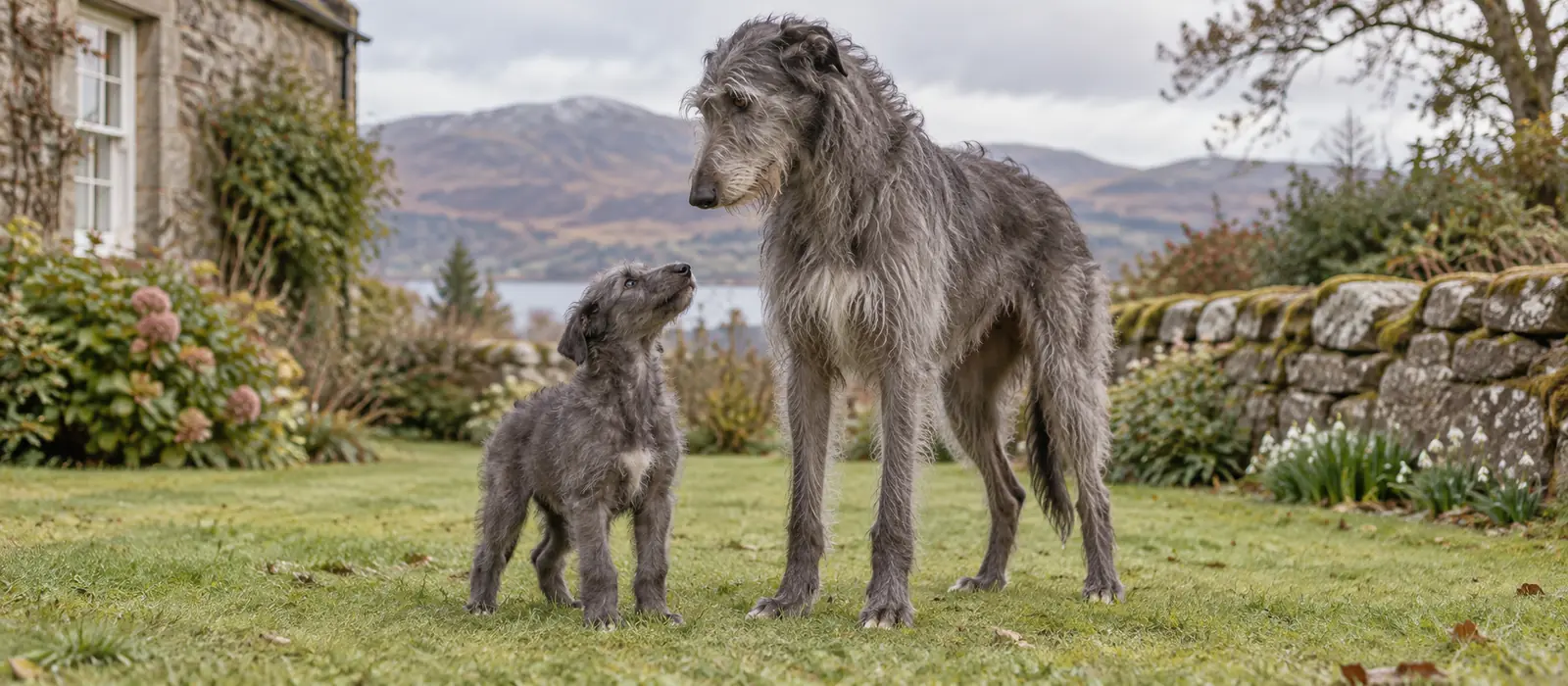
Understanding a Deerhound’s full-grown size helps prospective owners plan appropriately for space, feeding, and veterinary care. Scottish Deerhounds are giant-breed sighthounds, and their growth trajectory differs markedly from smaller breeds. This guide explains the breed’s standard measurements, typical growth patterns, and how to monitor development without relying solely on bathroom scales.
Breed Standard Measurements
The Kennel Club’s Breed Standard specifies minimum heights that define the breed:
Adult Dogs: Minimum 76 cm (30 inches) at the shoulder
Adult Bitches: Minimum 71 cm (28 inches) at the shoulder
These are minimums—many Deerhounds exceed these heights and reach 78–81 cm (30.5–32 inches). The breed’s elegant frame is often deceptive; despite their height, Deerhounds are relatively lean compared to broader giant breeds.
Typical adult weight ranges are:
Dogs: Approximately 45.5 kg (100 lbs)
Bitches: Approximately 36.5 kg (80 lbs)
These figures represent the Kennel Club’s assessment of the breed at proper condition. However, individual variation is significant. A large-framed dog might exceed 50 kg (110 lbs), whilst a smaller bitch may fall slightly below 36 kg. Genetics, early nutrition, and exercise all influence final size.
Giant-Breed Puppy Growth Patterns
Deerhound puppies grow remarkably quickly, reaching near-adult height by 9–12 months of age. This rapid growth places significant stress on skeletal, cartilaginous, and muscular systems. Understanding the growth process helps owners avoid practices that can compromise joint health and bone development.
Growth Plate Development
In giant breeds, the growth plates (epiphyses) at the ends of long bones remain open longer than in small breeds—often until 12–18 months, and in some cases extending to 24 months. Open growth plates are vulnerable to injury from excessive jumping, repetitive high-impact activities, and forced exercise. Protecting growth plates during this critical window reduces the risk of developmental orthopedic disease later in life.
Rapid Growth and Nutritional Demands
Giant-breed puppies gain weight rapidly and require carefully balanced nutrition. Overfeeding is a common mistake and carries serious consequences: excess calories accelerate growth rate, stressing bones and joints. Excess calcium and phosphorus, when unbalanced, can cause similar damage. Working with a veterinarian to select appropriate large-breed or giant-breed puppy food formulations is essential—these products are specifically formulated for slower, steadier growth compared to standard puppy foods.
Exercise During Growth
Contrary to intuition, large-breed puppies should not be exercised excessively or allowed unrestricted running on hard surfaces. Short, frequent, controlled walks are generally preferred over long walks or continuous free running while a puppy is still growing, with duration increased gradually as the puppy matures. At one year, controlled exercise can gradually increase towards adult levels, but discuss a suitable pace with your vet. Off-lead play with older, heavier dogs should be avoided until growth plates close, as collisions and repetitive jumping strain developing joints.
Rest is as important as exercise for developing Deerhounds. Puppies should have access to a padded, supportive resting area—orthopedic bedding is worthwhile investment. Forcing puppies to climb stairs, jump in and out of vehicles, or retrieve from water should be delayed until skeletal maturity.
When Deerhounds Reach Adult Size
Most Deerhounds reach their adult height (76–81 cm at shoulder) by 9–14 months of age. However, “filling out” continues beyond height achievement. The Deerhound’s lean frame gradually develops muscle mass over the second and third years of life. A two-year-old Deerhound may still be developing in shoulder width, chest depth, and muscle tone. Final adult condition is often not achieved until age 3 years.
This protracted development means young adult Deerhounds may look ungainly—tall and narrow—before maturing into the properly proportioned, athletic frame described in the Breed Standard. Patience and appropriate nutrition support this development without pushing growth.
Body Condition Scoring Instead of Scales
Weighing a Deerhound on bathroom scales has limitations. A heavily muscled dog and a pudgy dog of identical weight represent vastly different body conditions. The Kennel Club and veterinary professionals recommend using body condition scoring (BCS) instead, a visual and tactile assessment of your dog’s weight and proportion.
How to Assess Body Condition
A properly conditioned Deerhound at ideal weight should:
- Have ribs easily felt but not visibly protruding when standing
- Show a visible waist (narrowing) when viewed from above, between hips and rib cage
- Tuck the abdomen (no sagging belly) when viewed from the side
- Show a straight back line without a dip or bump at the hips
Place your hands on the dog’s ribs. In ideal condition, you should feel the ribs beneath light pressure, much as you feel your own ribs. If you cannot feel the ribs, the dog carries excess weight. If ribs are sharply visible and stand out prominently, the dog is underweight.
When to Weigh
Weighing remains useful as a monitoring tool across time. Weighing your Deerhound monthly or quarterly and recording the weight helps track trends. A stable weight over time, paired with good body condition, suggests appropriate feeding. Gradual weight gain in an adult dog suggests overconsumption; gradual loss in a dog with no other symptoms might suggest dental problems or illness.
Many veterinary clinics offer free weight-checks. Use these to establish a baseline adult weight, then assess body condition visually at home.
Feeding for Proper Growth and Maintenance
Feed large-breed or giant-breed puppy formulations during growth (until 12–18 months), as these are formulated to slow growth appropriately. Switch to adult large-breed or standard adult food once skeletal maturity is reached. Avoid general “puppy” formulations, which may contain excessive calcium and phosphorus for giant breeds.
Portion control is essential. Follow the feeding guidelines on your chosen food’s packaging, adjusted for your individual dog’s activity level and metabolism. Treat training with small, low-calorie treats or kibble from daily meals rather than high-calorie training rewards. A Deerhound is easily overfed with good intentions.
Monitoring Growth Milestones
6–8 weeks: Puppy adopts typical Deerhound proportions—long-legged, angular, and ungainly
3–6 months: Rapid height gain continues; baby teeth shed and adult teeth erupt
8–12 months: Near-adult height achieved; growth begins to slow
12–18 months: Growth plates close; physical maturity approaches
18–36 months: Muscling and overall definition develop; full adult frame emerges
Individual variation is normal. Some Deerhounds mature quickly; others grow slowly and fill out late. Patience, appropriate nutrition, and moderate, controlled exercise support healthy development.
Key points
- Adult Deerhounds reach minimum 76 cm (dogs) and 71 cm (bitches); typical weights 45.5 kg and 36.5 kg respectively
- Giant-breed puppies grow rapidly with vulnerable growth plates open until 12–24 months—excessive exercise risks joint damage
- Oversized portion control is critical; excess calories accelerate damaging growth rates
- Body condition scoring (rib-feel test, waist visibility) is more reliable than scales for assessing weight
- Final adult muscling develops across years 2–3, not by 12 months
Related: Deerhound help near you