Home › Guides › Collars and Harnesses for Sighthounds
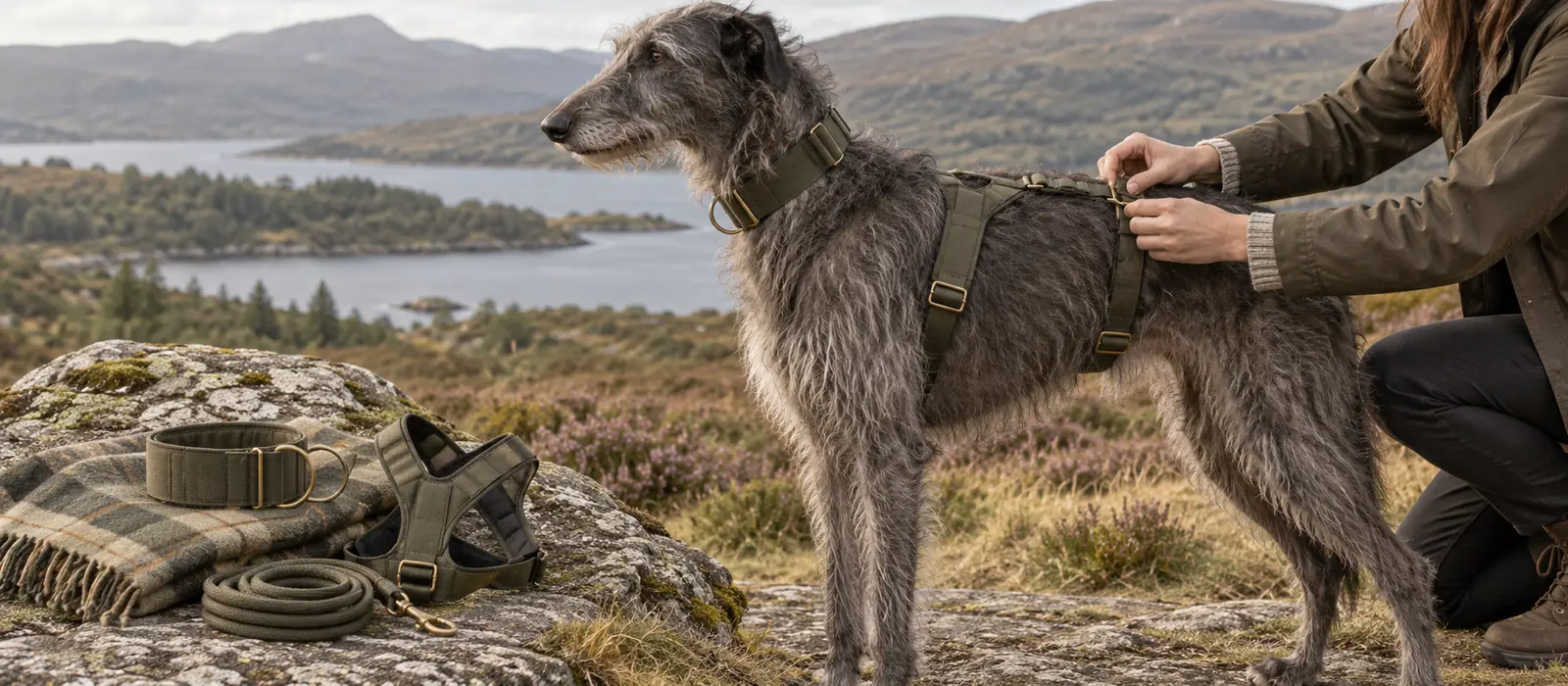
Sighthounds present a practical challenge many owners discover too late: a standard dog collar slides easily over a sighthound’s narrow, finely tapered head. Scottish Deerhounds, with their elegant proportions and long, narrow skulls, are escape artists when wearing ordinary collars. Understanding why this happens and choosing the right collar or harness prevents accidents, lost dogs, and legal non-compliance.
Why Sighthound Heads Slip Standard Collars
Sighthounds—a group that includes Deerhounds, Greyhounds, Whippets, and similar breeds—have evolved narrow, elongated skulls. The head tapers sharply from the skull to the muzzle, and the neck is slender and muscular. A standard collar that fits properly around the neck can slip backward over this narrow head if the dog pulls or turns sharply.
This is not a behavioural issue; it is anatomical. A collar that would hold securely on a Labrador or Springer Spaniel simply cannot grip the same way on a Deerhound’s narrow head. Many sighthound owners have experienced the moment when their dog slips the collar while on the lead and trots away—a terrifying situation in a busy street or near a road.
Additionally, sighthounds were bred to course game over open ground. Their prey drive is strong, and their acceleration is explosive. If spooked by a sudden noise or distracted by something to chase, a sighthound wearing an ill-fitting collar is at high risk of slipping it and running into danger.
Martingale Collars (Half-Check Collars)
The martingale collar is the traditional choice for sighthounds and remains highly effective. A martingale works by tightening as the dog pulls, preventing the collar from slipping backwards over the head.
How it works:
A standard collar loop is attached to a second, narrower loop. As the dog pulls or moves forward, the narrower loop tightens, cinching the main collar and preventing it from sliding backwards. When slack, the collar hangs loose and comfortable. The tightening is smooth and gradual, not a sudden choke or jerk.
Advantages:
- Prevents the collar slipping over the head
- Provides better control when leading or walking
- The tightening effect is gentle and safe when properly fitted
- Widely available and affordable
Proper fitting:
A martingale collar should be fitted so that when slack, you can fit two fingers underneath the main collar loop around the neck. When the dog pulls and the collar tightens, it should not cut into the neck or cause discomfort—it should simply hold firm without slipping. The narrower loop should be snug but not restrictive. Have your vet or an experienced sighthound owner check your fitting the first time to ensure it is correct.
Wide “Fishtail” Collars
Some sighthound owners prefer a wide, flat collar—often called a fishtail collar because of its broader, tapered shape. The additional width and surface area provide better grip on the neck and shoulders, reducing slip-over risk without requiring active tightening like a martingale.
Advantages:
- Distributes pressure more evenly across the neck
- Looks elegant and is less likely to chafe than narrower collars
- No active tightening mechanism; remains static
Disadvantages:
- Not as effective as a martingale at preventing slip-over in all situations
- Requires more careful fitting
If choosing a wide collar, select one specifically designed for sighthounds and ensure it is fitted securely.
Harnesses for Lead Walking and Car Travel
Harnesses distribute force across the chest and shoulders rather than concentrating it on the neck and throat. They are excellent for lead training puppies, for dogs with neck sensitivity, and for car travel safety.
Advantages:
- Prevents collar-related neck strain
- Excellent control for lead training without neck pressure
- Safe for restraint in vehicles (can be tethered to seat belts)
- Reduces risk of tracheal damage in dogs prone to coughing
Considerations:
- A poorly fitted harness can rub and chafe, particularly in active dogs
- Front-clip harnesses (where the lead attaches at the chest) are more effective for lead training than back-clip versions, as they discourage pulling
- Harnesses must be fitted carefully to ensure they do not slip off during vigorous activity
For a Deerhound, a well-fitted harness can replace a collar for indoor house training and early lead training. However, sighthound owners often use both: a martingale collar for secure everyday wear and identification, and a harness for specific purposes like vehicle restraint or heavy-duty lead work.
Identification Tags and Legal Requirements
Under the Control of Dogs Order 1992, UK law requires that dogs wear a collar and bear identification when in a public place or highway. Specifically, the collar must be inscribed with the name and address of the owner, either directly on the collar or on a plate or badge attached to it.
What this means in practice:
- Your Deerhound must wear a collar at all times when in public
- The collar must display your name and address (or these must be on a metal tag attached to the collar)
- A telephone number is strongly recommended, though not legally required
- A microchip is a legal requirement but is not a substitute for visible collar identification
An ID tag should be:
- Easily legible (engraved clearly or printed on durable plastic)
- Attached securely so it does not come loose
- Include your name, full address, and ideally a telephone number
- Colour-coded or shaped distinctively so a finder knows quickly that it is an ID tag
Many dogs found without ID tags spend weeks in local authority pounds awaiting collection, or are rehomed without their original owner’s knowledge. A visible, current ID tag is the fastest way for a stranger, vet, or council officer to return your dog to you.
No Chain or Slip-Chain Corrections
Training collars that tighten sharply (choke chains, slip chains, or prong collars) should not be used on sighthounds. These training tools were developed for different dog types and can cause serious harm to sighthounds’ sensitive necks and tracheas. Positive reinforcement training—using treats, praise, and play—is equally or more effective and is gentler on your dog.
Modern, humane training methods do not rely on aversive tools. If you need help with lead training or behaviour, consult a trainer certified in force-free methods rather than resorting to old-fashioned correction collars.
Fitting and Comfort
Regardless of collar choice, fit is paramount:
- Feel the neck: You should be able to fit two fingers comfortably under the collar when it is fastened. If you cannot, it is too tight; if you can fit four fingers, it is too loose.
- Check for chafing: After wearing the collar for an hour or two, inspect the neck for red marks, hair loss, or irritation. If any appear, adjust fit or switch to a different style.
- Consider coat texture: Rough-coated sighthounds like Deerhounds shed long guard hairs. Collar grooming—removing tangled hair around the neck—prevents mats and allows better fit.
- Replace as the dog grows: Puppies grow rapidly; a collar that fits perfectly at 4 months may be too small at 8 months. Check fit regularly.
Harness and Collar Together
Many sighthound owners use both a martingale collar (for everyday wear, ID, and security) and a harness (for vehicle restraint or specific lead-work situations). The collar provides identification and backup security; the harness provides ergonomic control and safety in specific contexts.
This dual approach offers flexibility and redundancy: if the harness is off, the collar remains secure; if the collar is removed for grooming, the harness can be used for lead walks.
Key points
- Sighthounds’ narrow heads slip standard collars; martingale collars prevent this by tightening as the dog pulls
- Martingale collars are the traditional, proven choice for Deerhounds when properly fitted (two-finger test)
- Wide fishtail collars offer an alternative if fitted securely
- Harnesses distribute pressure across the chest and are excellent for car restraint and lead training
- UK law requires dogs to wear a collar displaying owner’s name and address in public (microchip is complementary, not a substitute)
- ID tags should include name, address, and phone number; they are the fastest way for a stranger to reunite a lost dog with you
- Avoid choke chains and aversive training collars; sighthounds have sensitive necks and respond well to positive training methods
Related: Deerhound help near you